Last week I had the pleasure of observing a co-taught math lesson at Bell Herron Middle School in Carrollton, Ohio. As a motivational strategy, the teachers had designed a “Minute to Win It” activity for students who answered a math problem correctly. If you have not yet seen this game show, it is based on the idea that there are all kinds of tasks that can be done with simple materials found in the typical household. The tasks look easy at first, but can be quite challenging to accomplish in a minute.
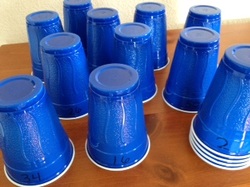
To tap into their students’ interest in this game show, the teachers chose a few of the tasks that could be simulated in the classroom. The one I observed involved the reordering of plastic cups – moving the top to the bottom, over and over again, until each cup had been moved once. The teachers began by projecting a youtube video of the game show’s countdown music and visuals. All the students gathered around to watch and cheer on their classmate. One minute later, success or no, students were back to work on the next problem in hopes that they would get to try Minute to Win It.
Whenever students find something of interest, it makes sense to see if we can find ways to tap into this for learning motivation. So many of the games on Minute to Win It lend themselves to studying the math and science behind successful completion. They also require higher level thinking skills to develop a strategy for winning. Many of the games can also be altered slightly to reinforce specific content. For example, the cup stacking activity can be changed to work on patterning.
Here’s what I did – using a water-based marker, I put an even number on each of 30 cups. Next, I mixed them up and stacked them so that only one number was showing. The “contestant” has to rearrange them so that they are in correct order from 2 to 60 in a minute. (You could use fewer cups for younger students.) You could also do this with alphabetizing words, sequencing colors, or any other concept that has a hierarchical nature. By adding content to the cups, the contestant and observers engage in quick thinking about your topic!
To tap into their students’ interest in this game show, the teachers chose a few of the tasks that could be simulated in the classroom. The one I observed involved the reordering of plastic cups – moving the top to the bottom, over and over again, until each cup had been moved once. The teachers began by projecting a youtube video of the game show’s countdown music and visuals. All the students gathered around to watch and cheer on their classmate. One minute later, success or no, students were back to work on the next problem in hopes that they would get to try Minute to Win It.
Whenever students find something of interest, it makes sense to see if we can find ways to tap into this for learning motivation. So many of the games on Minute to Win It lend themselves to studying the math and science behind successful completion. They also require higher level thinking skills to develop a strategy for winning. Many of the games can also be altered slightly to reinforce specific content. For example, the cup stacking activity can be changed to work on patterning.
Here’s what I did – using a water-based marker, I put an even number on each of 30 cups. Next, I mixed them up and stacked them so that only one number was showing. The “contestant” has to rearrange them so that they are in correct order from 2 to 60 in a minute. (You could use fewer cups for younger students.) You could also do this with alphabetizing words, sequencing colors, or any other concept that has a hierarchical nature. By adding content to the cups, the contestant and observers engage in quick thinking about your topic!
 RSS Feed