Picture
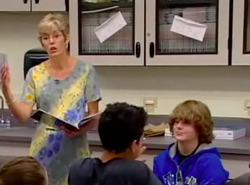
    On a whirlwind tour of classrooms in Smyrna, Delaware this week, I saw a teacher use a simple strategy for engaging students. The teacher had 10  paper lunch bags, one for each small group to share. Inside the bags she had placed 26 cards, each with one letter of the alphabet. The lesson objective was to identify and discuss the impact of the narrative elements in a story. Students were listening to the teacher read, and reading along in their own books. Every so often, the teacher stopped, directed the students to pull a letter out of their “letter bag,” and then make a connection between the letter and a narrative element. For example, one group pulled an “O” and discussed how the setting of the story was “outdoors.” Another group pulled an “E” and wondered what the “exciting” climax would be.

      This is the type of strategy I love for 3 reasons:

1.     Highly engaging – it was multi-modality and had an element of unpredictability that students immediately loved
2.     Highly applicable – the same strategy could be used to encourage connections to any content discussion, as an activator, or even as a summarizing moment, K-12!
3.     Low prep – such a quick thing to put together


Picture
One of my teammates has a student in her class this year that falls somewhere on the autism spectrum – location yet to be determined. He is a bright young man with loads of energy and an inquisitive mind. As Thomas Armstrong suggests, in a recent article in Educational Leadership, he is neurally diverse with many strengths. However, his diversity challenges teachers to think differently about ways to capture his interest.

During a recent lesson, I happened to mention something about puzzles. This student impulsively shouted, “Puzzles? I love puzzles! They are my favorite things in the whole world.” Eureka! – an insight into a possible engagement strategy.

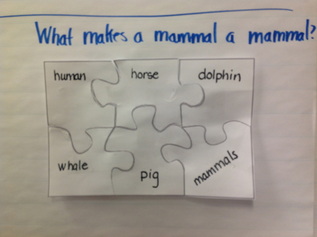
My colleague snatched the ball and ran with it. She and her grade level partners developed an interactive approach that incorporated jigsaw puzzles. A science unit on animals became a puzzle piecing activity for all students, reinforcing the concepts of structures and connections. The targeted student was highly engaged, as were all the other students in the class. The teachers all agree that it was a successful approach that will be used again next year.

Neural diversity brings much to a classroom. Celebrate it this week!


P.S. We have also used an iPad app called JigsawBox that allows you to turn any photo into an interactive jigsaw puzzle. For more app ideas, join me at an IED seminar I will be offering in March on the Best Apps for Differentiating Instruction. Registration will begin in a few weeks for Indianapolis (3/18), Atlanta (3/19), Chicago (3/20 & 3/21) and Denver (3/22.) 


Picture
During a unit on informational texts, I took photos of papers that showed the features of different types. We then turned them into puzzles using the Jigsaw Box app.
 
 
Picture
This week I had the opportunity to work with ELL specialists and their co-teachers in Cherry Creek Schools. One of our activities involved generating higher level thinking questions to engage students. Below are some of the creative ideas the co-teachers developed. Try stuffing each one in an envelope and posting the envelopes on the walls of your classroom (as seen in the photo.) Near the end of the lesson, ask a student to randomly choose one of the envelopes and read the question aloud. A great way to stimulate interesting thought and discussion!

  • If this concept were an app, what would it be called and what would it do?
  • How might _____ culture affect your perspective on this topic?
  • If you were to perform a dance about this concept what would it look like?
  • If you were to make a cartoon out of this concept, who would the characters be and what would they be doing?
  • If this concept was represented on a magazine cover, what would it look like and why?
  • If this concept was made into a video game, how would you get the high score or win the game?
  • If this concept/situation went very badly, what would you learn from it and why?
  • If you were to dress up as this concept for a costume party, what would it look like and why?
  • If this concept were a business, what would its tag line be? 
  • If you were stranded on a deserted island, what would you do with this concept?


Picture
Encourage students to make connections between what they are learning in class and the larger world around them. 

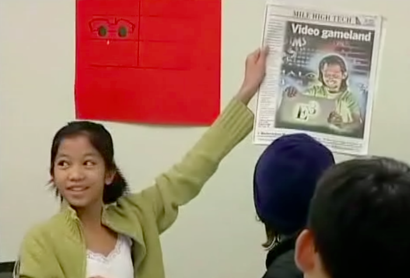
Bring in a pile of newspapers or choose some online news sites. Give each student a section of the paper and ask them to find something, anything, in the paper that relates to the concept or vocabulary term you are learning. 

For example, in a middle school math lesson on polygons, students searched the paper for something related to polygons. After a few moments, students shared their findings with the whole class. Examples included: a picture of a cell phone, a basketball court, a corporate logo and a boxed ad. 


Picture
With the school year coming to a close, this is a great time for students to share their knowledge with next year’s incoming class. One strategy for accomplishing this is “Pay it Forward Post-Its.”

Here’s how we used it this week. I was working with students on

 CCS RI.4.5. Describe the overall structure (e.g., chronology, comparison, cause/effect, problem/solution) of events, ideas, concepts, or information in a text or part of a text.

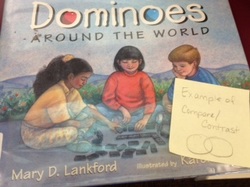
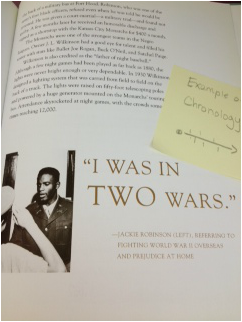
After students had a solid understanding of the different types of informational text, they were each given several sticky notes. At the top of each they were directed to write “Example of _______,” filling in the text type name. Underneath, they drew a visual representation that might aid their comprehension or note taking. For example, underneath “Example of Compare/Contrast” might be a Venn Diagram.

Students were then given time to wander the classroom, looking for informational texts. As they browsed a text, they looked for a page on which they could stick their note, showing a good example of that text type. These sticky notes will be left in the books until next year, when new students will come across them as they explore books. This will expose the new students to the concepts and vocabulary in real contexts.

Pay it Forward Post-Its can be used in a variety of content areas. For example, students in a math class could place sticky notes in their math texts that identify certain types of problem solving (i.e. decomposition.) Students in social studies could place sticky notes that identify specific types of conflict (i.e. territorial.) Next year’s students will have a head start on understanding these concepts by occasionally coming across these notes, and this year's students have an opportunity to reinforce their current understanding before heading off on vacation. A win-win!


This is your new blog post. Click here and start typing, or drag in elements from the top bar.