Memory researchers tell us that in order for learners to move information from short term to long term memory, they must recode the information into their own words.
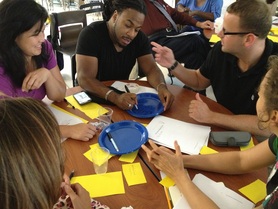
Today, after teaching new math terms, we asked students to develop definitions in their own words. Students then worked together in small groups to share definitions and choose one that they felt was the best.
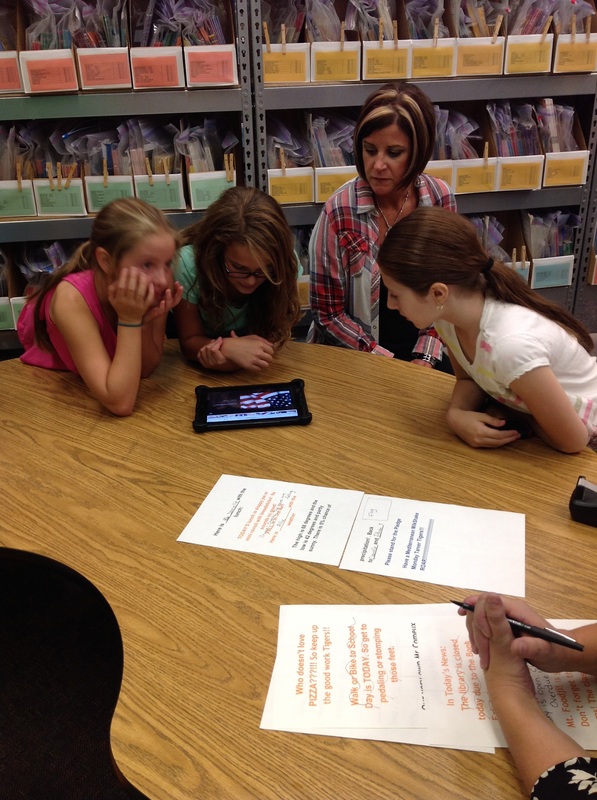
I then introduced students to an iPad app called MailVU or video mail (FREE). This app is a very simple, intuitive way to take a brief video and email it to someone. We used the app to video students reading the chosen definitions, and then emailed them to the school principal. Students loved chanting,"You just got sent to the principal's office!"
This app has some great features - the sender can choose to be notified when the email has been read, and can choose to have the video self-destruct after a chosen number of viewings. Students especially liked the self-destruct feature.
Here are some other great ideas for using this app in your classroom:
- When a student forgets something again (a signed permission slip, homework, etc.) he could use MailVU to send an video email reminder to his parent.
- If a student accomplishes something special in class, send a video mail to celebrate the accomplishment.
- Capture the student demonstrating an intermittent, inappropriate behavior and email it to the behavior specialist.
For the last few years I have been collaborating with a Nebraska school district to improve their co-teaching practices. Through a series of workshops, observations and job-embedded modeling, teachers have engaged in analysis and reflection. I am excited to see so many teachers embracing new ideas for engagement and hands-on learning!
Last week I visited co-taught classrooms at two different middle schools, both teaching author’s purpose using the RIPE acronym (Reflect, Inform, Persuade, Entertain.)
In one class, the co-teachers used a novel approach to activate student thinking. They began class by putting on banana necklaces! Students immediately wondered what was happening, and started making predictions. What a creative, novel way to activate learning! (For more ideas about novelty, download a Novelty Schedule on this website's downloadables page.)
In the other class, the co-teachers chose to use “cootie catchers” (also known as fortune tellers) to increase their students’ motivation. The teachers made the largest cootie catcher I have ever seen and used it as a model. What I loved about this was that it was impossible for one person to manipulate – it had to be collaborative. Students then made smaller versions and paired up to practice their knowledge of the four author purposes. Watch this video clip from the BER video Making Inclusion More Successful.
Recently I was asked about ideas for engaging students in cooperative reading. One that has stood the test of time is called Reading Trios. I originally learned this strategy as part of a reading comprehension workshop by Dr. Ed Gickling. It is both simple and effective, two criteria that are important to most teachers. It can also be used at any grade level or in any content area.
Begin by assigning students to trios. Generally, it is best to make these mixed-ability trios if everyone will be reading the same content.
One student takes on the role of READER. Her task is to read aloud the text (usually 1 – 3 paragraphs.)
One student takes on the role of RETELLER. His task is to retell what was read aloud to their trio.
One student takes on the role of CHECKER. Her task is to listen closely and try to catch the reteller missing something.
Engagement levels are very high during Reading Trios. Why? The READER is reading aloud, the RETELLER is paying very close attention because they don’t want to get caught missing something, and the CHECKER is engaged because they hope to catch the reteller missing something.
An additional benefit of this strategy is that it provides valuable roles for students who may not be strong at reading aloud. Often, students with reading disabilities have learned to be very good listeners.
I facilitated this strategy in three different classrooms last month and all three teachers agreed that it is an approach they will add to their reading tool kit.
Interested in seeing the strategy in action? View this excerpt from a BER video entitled Making Inclusion More Successful and see fourth graders using reading trios to explore social studies text.
On a whirlwind tour of classrooms in Smyrna, Delaware this week, I saw a teacher use a simple strategy for engaging students. The teacher had 10 paper lunch bags, one for each small group to share. Inside the bags she had placed 26 cards, each with one letter of the alphabet. The lesson objective was to identify and discuss the impact of the narrative elements in a story. Students were listening to the teacher read, and reading along in their own books. Every so often, the teacher stopped, directed the students to pull a letter out of their “letter bag,” and then make a connection between the letter and a narrative element. For example, one group pulled an “O” and discussed how the setting of the story was “outdoors.” Another group pulled an “E” and wondered what the “exciting” climax would be.
This is the type of strategy I love for 3 reasons:
1. Highly engaging – it was multi-modality and had an element of unpredictability that students immediately loved 2. Highly applicable – the same strategy could be used to encourage connections to any content discussion, as an activator, or even as a summarizing moment, K-12! 3. Low prep – such a quick thing to put together
Yesterday I had the opportunity to work with students on building skills for writing a cause/effect essay. As a thought activator, I asked students to quickly line up some Legos I provided so that I could demonstrate the domino effect. Students worked in pairs to observe what occurred, talk about it and record the types of transition words they used to describe the cause/effect experience.
Next, I provided them with graphic organizer puzzle pieces. I modeled how one might plan for a cause/effect paper, including key transition words on the bridge shapes. Because we used puzzle pieces, instead of a static piece of paper, students were able to brainstorm first and then move pieces around to cluster their ideas. As a final step, they will put them into a sequence before they write their paper.
If you would like the graphic organizer puzzle shapes, email me at anne@ideasforeducators.com and I will happily send them to you!
I love Wikki Stix for encouraging students to develop abstract, symbolic representations of concepts. At a recent workshop with 4th grade math teachers, I asked them to use Wikki Stix to represent the concept of skip counting. Here are a few photos of their products!
This photo shows three students playing double dutch, chanting "2, 4, 6, 8...." in their rhyme as they jump.
This photo shows skip counting by 3s to 6 at the top in yellow, then by 2s, then by 1.5s and finally counting by 1s at the bottom.
This representation shows skip counting in a number line fashion with a small person at the top, jumping, and colors that show odd and even numbers.
One of my teammates has a student in her class this year that falls somewhere on the autism spectrum – location yet to be determined. He is a bright young man with loads of energy and an inquisitive mind. As Thomas Armstrong suggests, in a recent article in Educational Leadership, he is neurally diverse with many strengths. However, his diversity challenges teachers to think differently about ways to capture his interest.
During a recent lesson, I happened to mention something about puzzles. This student impulsively shouted, “Puzzles? I love puzzles! They are my favorite things in the whole world.” Eureka! – an insight into a possible engagement strategy.
My colleague snatched the ball and ran with it. She and her grade level partners developed an interactive approach that incorporated jigsaw puzzles. A science unit on animals became a puzzle piecing activity for all students, reinforcing the concepts of structures and connections. The targeted student was highly engaged, as were all the other students in the class. The teachers all agree that it was a successful approach that will be used again next year.
Neural diversity brings much to a classroom. Celebrate it this week!P.S. We have also used an iPad app called JigsawBox that allows you to turn any photo into an interactive jigsaw puzzle. For more app ideas, join me at an IED seminar I will be offering in March on the Best Apps for Differentiating Instruction. Registration will begin in a few weeks for Indianapolis (3/18), Atlanta (3/19), Chicago (3/20 & 3/21) and Denver (3/22.)
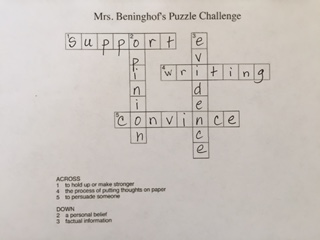
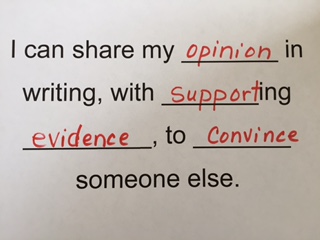
During a unit on informational texts, I took photos of papers that showed the features of different types. We then turned them into puzzles using the Jigsaw Box app.
Encourage students to make connections between what they are learning in class and the larger world around them.
Bring in a pile of newspapers or choose some online news sites. Give each student a section of the paper and ask them to find something, anything, in the paper that relates to the concept or vocabulary term you are learning.
For example, in a middle school math lesson on polygons, students searched the paper for something related to polygons. After a few moments, students shared their findings with the whole class. Examples included: a picture of a cell phone, a basketball court, a corporate logo and a boxed ad.
Last week I had the wonderful opportunity to meet a dynamic co-teaching pair, Nicole Martin and Jenny Tuttle, at Franklin Middle School in Franklin, NH. They had previously attended a workshop I gave in which I shared an idea for using plastic picnic plates with transparency markers. They decided to tweak and twist my idea and came up with Instructional Twister. As you can see from the photo they took four different colors of plates and laid them out on the floor, Twister style. Using transparency (water-based) markers, they wrote vocabulary from their recycling/ecology unit. The teacher would call out a definition and the student had to find the correct plate to place a hand or foot. If needed, the teacher would provide a hint by sharing the color. Jenny and Nicole said their middle school science students loved it! I love it because it is multi-sensory, has a game-like feel for students, and requires very little work on the part of teachers! Thanks for sharing your idea! Do you have an idea you would be willing to share with teachers around the country? If so, please email me and add a photo if you have one. The more we collaborate, the better our instruction can become!
A Tic-Tac-Toe menu – a project oriented assignment that allows students to choose three of nine tasks – can incorporate all three of the major approaches to differentiation. Student interest is heightened by allowing choice; learning style is addressed by designing a variety of tasks; readiness is met by leveling the tasks. I suggest leveling each row of tasks (higher complexity, on-level, lower complexity) and linking points to each row (30, 20, 10.) Tell your students that they must earn a total of 40 points. This insures that all students will complete at least one on-level task. If you make the higher complexity tasks interesting enough, you will find that students who are ready for challenge often choose to do two of these!
Here is a photo and an attached document of a leveled tic-tac-toe menu designed by some creative third grade teachers in Cheltenham Township. If you don’t teach this particular math concept, I think you will still be able to see how to change some of the words and tweak it to fit your content.
 | tic-tac-toe_area_.docx | | File Size: | 88 kb | | File Type: | docx | Download File
|