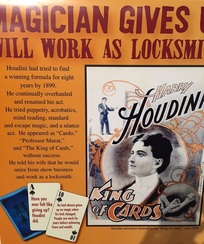
Always on the search for new ways to motivate students to read carefully and closely, I decided to craft a lesson about being an escape artist. Two recent experiences inspired this lesson - a trip to the awesome Denver Escape Room and a visit to a Houdini museum exhibit in Appleton, WI.
Students were "locked" into Room 1, our first Google doc. In order to escape, they had to read this document and answer the questions (questions represented the lowest two levels of Bloom's Taxonomy.) If they answered correctly, they were given a code by the teacher (a tiny url) that would get them into Room 2. Again, they had to read text and answer questions, this time from the two middle levels of Bloom's Taxonomy. If correct, they received the code to get into Room 3 where they encountered a high level challenge based on our recent energy unit.
Check out and download the documents here.
Escape Room 1
Escape Room 2
Escape Room 3
Because escape artists usually have time constraints, we projected a visual timer on the board and gave students 40 minutes to try to escape all three rooms. Individual accommodations were made for a few students (text to speech, visual highlighting of key sections, etc.) and an extra challenge for early finishers.
Motivation and engagement was very high. However, we also had students who were highly frustrated. (Most of the mistakes came from rushing or not attending to details.) This led to great conversation with students about the need for persistence in the face of difficulty.
The structure worked really well and my co-teachers and I are already planning on designing more of these for next year. We will try to use text and questions that we already have, rather than creating from scratch like I did with this lesson. As student skills progress during the year, the escapes can become more challenging.
If any of my supremely tech savvy followers can think of a way to do this even more seamlessly, please let me know!
Students were "locked" into Room 1, our first Google doc. In order to escape, they had to read this document and answer the questions (questions represented the lowest two levels of Bloom's Taxonomy.) If they answered correctly, they were given a code by the teacher (a tiny url) that would get them into Room 2. Again, they had to read text and answer questions, this time from the two middle levels of Bloom's Taxonomy. If correct, they received the code to get into Room 3 where they encountered a high level challenge based on our recent energy unit.
Check out and download the documents here.
Escape Room 1
Escape Room 2
Escape Room 3
Because escape artists usually have time constraints, we projected a visual timer on the board and gave students 40 minutes to try to escape all three rooms. Individual accommodations were made for a few students (text to speech, visual highlighting of key sections, etc.) and an extra challenge for early finishers.
Motivation and engagement was very high. However, we also had students who were highly frustrated. (Most of the mistakes came from rushing or not attending to details.) This led to great conversation with students about the need for persistence in the face of difficulty.
The structure worked really well and my co-teachers and I are already planning on designing more of these for next year. We will try to use text and questions that we already have, rather than creating from scratch like I did with this lesson. As student skills progress during the year, the escapes can become more challenging.
If any of my supremely tech savvy followers can think of a way to do this even more seamlessly, please let me know!





 RSS Feed