Picture
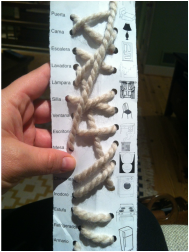
Yesterday, I had the pleasure of meeting Heather Newman, a high school Spanish teacher in Delaware. Heather participated in a workshop I facilitated on co-teaching and differentiated instruction. One of our conversations concerned the need to add tactile and kinesthetic instruction to our lessons, no matter how old our students are. Heather showed this photo to me and explained how she had her Spanish 1 students match vocabulary to pictures using yarn. What a creative idea! She reported that her students loved it, commenting that it was so much better than another worksheet. Thanks for sharing, Heather!


Picture
Memory researchers tell us that in order for learners to move information from short term to long term memory, they must recode the information into their own words. 

Today, after teaching new math terms, we asked students to develop definitions in their own words. Students then worked together in small groups to share definitions and choose one that they felt was the best. 

I then introduced students to an iPad app called
MailVU or video mail (FREE). This app is a very simple, intuitive way to take a brief video and email it to someone. We used the app to video students reading the chosen definitions, and then emailed them to the school principal. Students loved chanting,"You just got sent to the principal's office!"


This app has some great features - the sender can choose to be notified when the email has been read, and can choose to have the video self-destruct after a chosen number of viewings. Students especially liked the self-destruct feature.


Here are some other great ideas for using this app in your classroom:
  • When a student forgets something again (a signed permission slip, homework, etc.) he could use MailVU to send an video email reminder to his parent.
  • If a student accomplishes something special in class, send a video mail to celebrate the accomplishment.
  • Capture the student demonstrating an intermittent, inappropriate behavior and email it to the behavior specialist.


Picture
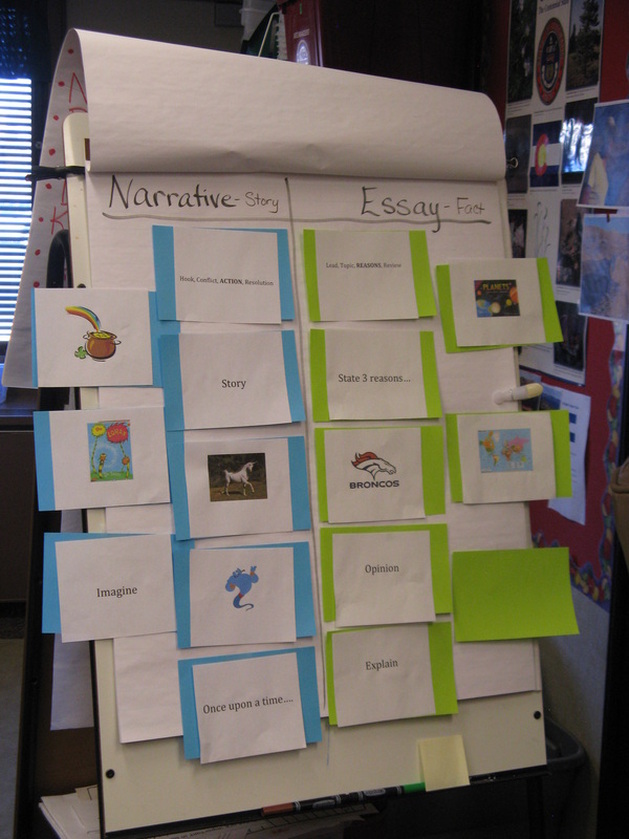
   T-Charts are a common graphic organizer to assist students in thinking about the differences between two things that are related in some way. At times they are used to show examples and non-examples of one thing. Visually, they typically look like an capital or lowercase t. 

   For students who struggle with language, whether because they are learning English or a student with a disability, T-charts can be enhanced by using pictures in addition to the traditional words. Here is a photo of a student-generated T-chart to show the differences between narrative writing and expository essay writing. Students worked with a partner. Each pair was given a paper with either a word or a picture. Pairs came up and placed the paper in the correct column and justified their decision.


  Research is clear that non-linguistic representations are very powerful. The next time you are using a graphic organizer, whether on chart paper or the computer,  consider adding simple drawings, printed pictures, or photos. 


Picture
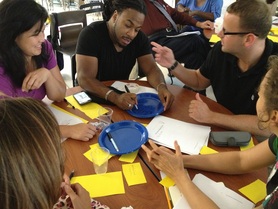
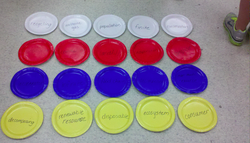
Last week I had the wonderful opportunity to meet a dynamic co-teaching pair, Nicole Martin and Jenny Tuttle, at Franklin Middle School in Franklin, NH. They had previously attended a workshop I gave in which I shared an idea for using plastic picnic plates with transparency markers. They decided to tweak and twist my idea and came up with Instructional Twister.

As you can see from the photo they took four different colors of plates and laid them out on the floor, Twister style. Using transparency (water-based) markers, they wrote vocabulary from their recycling/ecology unit. The teacher would call out a definition and the student had to find the correct plate to place a hand or foot. If needed, the teacher would provide a hint by sharing the color. 

Jenny and Nicole said their middle school science students loved it! I love it because it is multi-sensory, has a game-like feel for students, and requires very little work on the part of teachers! Thanks for sharing your idea!

Do you have an idea you would be willing to share with teachers around the country? If so, please email me and add a photo if you have one. The more we collaborate, the better our instruction can become!


Picture
With the school year coming to a close, this is a great time for students to share their knowledge with next year’s incoming class. One strategy for accomplishing this is “Pay it Forward Post-Its.”

Here’s how we used it this week. I was working with students on

 CCS RI.4.5. Describe the overall structure (e.g., chronology, comparison, cause/effect, problem/solution) of events, ideas, concepts, or information in a text or part of a text.

After students had a solid understanding of the different types of informational text, they were each given several sticky notes. At the top of each they were directed to write “Example of _______,” filling in the text type name. Underneath, they drew a visual representation that might aid their comprehension or note taking. For example, underneath “Example of Compare/Contrast” might be a Venn Diagram.

Students were then given time to wander the classroom, looking for informational texts. As they browsed a text, they looked for a page on which they could stick their note, showing a good example of that text type. These sticky notes will be left in the books until next year, when new students will come across them as they explore books. This will expose the new students to the concepts and vocabulary in real contexts.

Pay it Forward Post-Its can be used in a variety of content areas. For example, students in a math class could place sticky notes in their math texts that identify certain types of problem solving (i.e. decomposition.) Students in social studies could place sticky notes that identify specific types of conflict (i.e. territorial.) Next year’s students will have a head start on understanding these concepts by occasionally coming across these notes, and this year's students have an opportunity to reinforce their current understanding before heading off on vacation. A win-win!


This is your new blog post. Click here and start typing, or drag in elements from the top bar.
 
 
Picture
Many teachers use the Frayer Model (1969) as a vocabulary application activity. The Frayer Model typically involves asking students to fold or divide their paper into four sections. In one quadrant the students write the word and definition, in another they write facts/characteristics, in another quadrant examples, and finally non-examples.

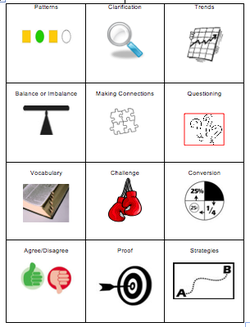
To mix things up a bit, last week I asked a co-teacher to replace her use of the Frayer Model in algebra with a Word Toss activity. We placed students into pairs and provided each pair with a die and a Word Toss worksheet. (See below. I'd be happy to email the worksheet to you!) Students were directed to role the dice and perform the task associated with the number on the face of their die.

The change in routine increased alertness by adding some novelty and tactile interaction to the lesson. Afterward, my co-teacher and I brainstormed alternative tasks that could go on the Word Toss worksheet:


  • Act it out
  • Develop a metaphor
  • Develop an analogy
  • Create a multiple choice question
  • Perform word surgery (dissect into root, prefix, suffix)
  • Transform it (add prefix or suffix)
  • Career Track it (think of a job for which you would need this word)
  • Create a crossword clue