***Note: Because my new website does not include archives before February, 2012, I will occasionally repost old favorites. Here's one!
Graphic Organizers are frequently used in classrooms as an aid to comprehension and organization. While I have been using them for many years, I have only found them to be most effective since developing them into interactive puzzles. Students find the puzzles to be more engaging and concrete than the 2 dimensional paper and pencil tasks.
We started using the GO Puzzles for writing by laminating lots a basic shapes. Students would develop a plan by brainstorming their ideas, writing (with transparency markers) on the laminated puzzle pieces, and then arranging them in the sense that made the most sentence for their paper. We eventually added shapes that represented the 5 senses to encourage students to plan sensory detail into their writing. These shapes are available in my book Engage All Students through Differentiation.
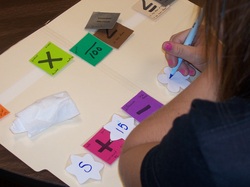
Recently I presented a workshop in North Dakota and shared this idea with teachers. Vicki, a middle school math teacher, took the idea and soared with it! She used a different color of paper for each operation, added words that are commonly associated with the process, and put it all together in laminated folders. Students used the organizers at the beginning of an algebra unit to start writing expressions and equations from story problems. Vicki reported that students were highly engaged, especially when given the opportunity to move around and show their work to their peers.
Thanks, Vicki, for sharing your twist on this idea!
Graphic Organizers are frequently used in classrooms as an aid to comprehension and organization. While I have been using them for many years, I have only found them to be most effective since developing them into interactive puzzles. Students find the puzzles to be more engaging and concrete than the 2 dimensional paper and pencil tasks.
We started using the GO Puzzles for writing by laminating lots a basic shapes. Students would develop a plan by brainstorming their ideas, writing (with transparency markers) on the laminated puzzle pieces, and then arranging them in the sense that made the most sentence for their paper. We eventually added shapes that represented the 5 senses to encourage students to plan sensory detail into their writing. These shapes are available in my book Engage All Students through Differentiation.
Recently I presented a workshop in North Dakota and shared this idea with teachers. Vicki, a middle school math teacher, took the idea and soared with it! She used a different color of paper for each operation, added words that are commonly associated with the process, and put it all together in laminated folders. Students used the organizers at the beginning of an algebra unit to start writing expressions and equations from story problems. Vicki reported that students were highly engaged, especially when given the opportunity to move around and show their work to their peers.
Thanks, Vicki, for sharing your twist on this idea!


 RSS Feed

