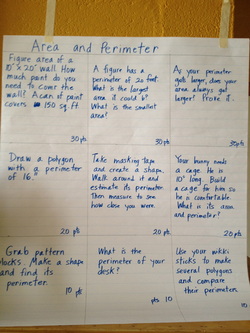
A Tic-Tac-Toe menu – a project oriented assignment that allows students to choose three of nine tasks – can incorporate all three of the major approaches to differentiation. Student interest is heightened by allowing choice; learning style is addressed by designing a variety of tasks; readiness is met by leveling the tasks. I suggest leveling each row of tasks (higher complexity, on-level, lower complexity) and linking points to each row (30, 20, 10.) Tell your students that they must earn a total of 40 points. This insures that all students will complete at least one on-level task. If you make the higher complexity tasks interesting enough, you will find that students who are ready for challenge often choose to do two of these!
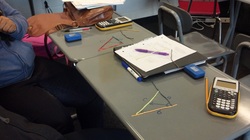
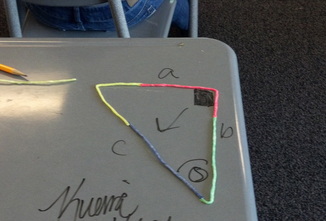
Here is a photo and an attached document of a leveled tic-tac-toe menu designed by some creative third grade teachers in Cheltenham Township. If you don’t teach this particular math concept, I think you will still be able to see how to change some of the words and tweak it to fit your content.

| tic-tac-toe_area_.docx |
| File Size: | 88 kb |
| File Type: | docx |
Download File
Automaticity with math facts is essential for student success with higher level problem solving. When students are unable to quickly (3 seconds or less) know the answer to basic facts, it slows down every other step in mathematics. Unfortunately, most students see math fact practice as boring and irrelevant. Our job as teachers is to find lots of ways to keep math fact practice novel and engaging.
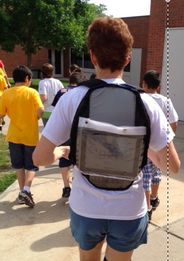
This past week students and staff at an elementary school in my community held a FUNdraising run. I decided to run with them and to incorporate math fact practice while running! I went to a second-hand shop and purchased an old backpack. I cut off the "pack" part, leaving just the back and straps. Then I picked up a heavy duty, clear plastic shower curtain liner. I cut a portion twice the size of my iPad and sewed a pocket with it onto the back of the pack. My iPad fit very snuggly, so that it wouldn't fall out as I ran. Finally, I created a Keynote presentation - each slide was a single math fact or a cheer such as "Go, go, go!" I set the slide show to run automatically, changing slides about every 10 seconds.
Students were challenged to shout out the math fact and answer if they passed me on the run. If I passed the students, they also had to call out the fact and the answer. Watch this short video clip to see how it came together!
With the school year coming to a close, this is a great time for students to share their knowledge with next year’s incoming class. One strategy for accomplishing this is “Pay it Forward Post-Its.”
Here’s how we used it this week. I was working with students on
CCS RI.4.5. Describe the overall structure (e.g., chronology, comparison, cause/effect, problem/solution) of events, ideas, concepts, or information in a text or part of a text.
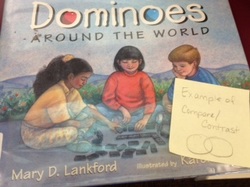
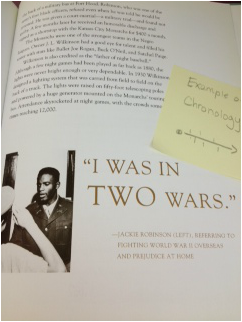
After students had a solid understanding of the different types of informational text, they were each given several sticky notes. At the top of each they were directed to write “Example of _______,” filling in the text type name. Underneath, they drew a visual representation that might aid their comprehension or note taking. For example, underneath “Example of Compare/Contrast” might be a Venn Diagram.
Students were then given time to wander the classroom, looking for informational texts. As they browsed a text, they looked for a page on which they could stick their note, showing a good example of that text type. These sticky notes will be left in the books until next year, when new students will come across them as they explore books. This will expose the new students to the concepts and vocabulary in real contexts.
Pay it Forward Post-Its can be used in a variety of content areas. For example, students in a math class could place sticky notes in their math texts that identify certain types of problem solving (i.e. decomposition.) Students in social studies could place sticky notes that identify specific types of conflict (i.e. territorial.) Next year’s students will have a head start on understanding these concepts by occasionally coming across these notes, and this year's students have an opportunity to reinforce their current understanding before heading off on vacation. A win-win!
This is your new blog post. Click here and start typing, or drag in elements from the top bar.
Last week I had the good fortune to attend the CEC conference in Denver, CO. One of the sessions dealt with memory. The presenter reminded us of a principal called the "
primacy-recency effect." This refers to the fact that most people remember best what they hear first and last within a lesson. This is one of the reasons that it is so important for teachers to purposefully plan an activator and closure component in each lesson.
One of my favorite closure activities is called
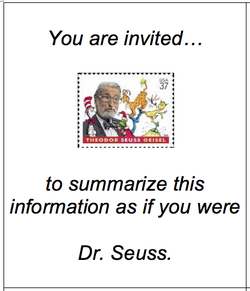
Celebrity Summaries. I made up cards that look like the one shown, with a variety of celebrities. Make sure you choose celebrities your students will know. After placing students in small groups, I have them choose a card and develop a brief summary or review of the lesson from that celebrity's perspective. Today I had the opportunity to model this activity with teachers attending a workshop I gave on differentiated instruction in WV. Here are two of the summaries they developed and shared in the final five minutes of the day.
From Albert Einstein: DI = C(SL3) Translation -Differentiated Instruction equals creativity times student learning due to addressing 1. Learning profile, 2. Readiness level, 3. Student interest.
From Dr. Seuss:
Differentiation is easy, don't you see
Stand up, sit down, manipulate with me
Wikki Stix, sticky dots and HOT questions on the wall
We do our best to include them all!
This is your new blog post. Click here and start typing, or drag in elements from the top bar.