For the last few years I have been collaborating with a Nebraska school district to improve their co-teaching practices. Through a series of workshops, observations and job-embedded modeling, teachers have engaged in analysis and reflection. I am excited to see so many teachers embracing new ideas for engagement and hands-on learning!

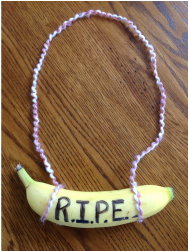
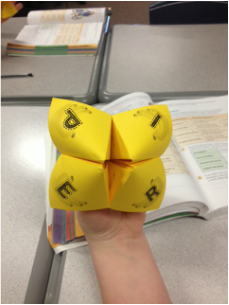
Last week I visited co-taught classrooms at two different middle schools, both teaching author’s purpose using the RIPE acronym (Reflect, Inform, Persuade, Entertain.)


Picture
In one class, the co-teachers used a novel approach to activate student thinking. They began class by putting on banana necklaces! Students immediately wondered what was happening, and started making predictions. What a creative, novel way to activate learning! (For more ideas about novelty,  download a Novelty Schedule on this website's downloadables page.)  

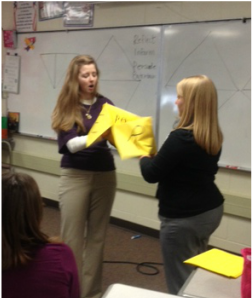
In the other class, the co-teachers chose to use “cootie catchers” (also known as fortune tellers) to increase their students’ motivation. The teachers made the largest cootie catcher I have ever seen and used it as a model. What I loved about this was that it was impossible for one person to manipulate – it had to be collaborative. Students then made smaller versions and paired up to practice their knowledge of the four author purposes. Watch this video clip from the BER video Making Inclusion More Successful.


Picture
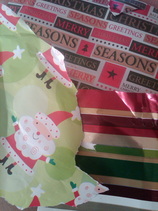
‘Tis the season…to rip paper off of gifts! If that happens in your home, be sure to save as many scraps of paper as you can. Cut them into small pieces (about 4x4). Hand them out to students in the New Year and provide them with a writing prompt meant to elicit a brief response. After students have written their response, direct them to fold the paper up as if it was a gift, and exchange it with a peer.

Such a simple way to add some novelty, emphasize that sharing ideas is similar to gift giving, and reuse wrapping paper! 

Merry Christmas and Happy New Year!


Picture
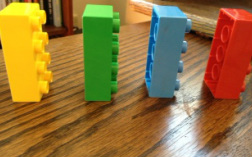
   Yesterday I had the opportunity to work with students on building skills for writing a cause/effect essay. As a thought activator, I asked students to quickly line up some Legos I provided so that I could demonstrate the domino effect. Students worked in pairs to observe what occurred, talk about it and record the types of transition words they used to describe the cause/effect experience.


Picture
  

    Next, I provided them with graphic organizer puzzle pieces. I modeled how one might plan for a cause/effect paper, including key transition words on the bridge shapes. Because we used puzzle pieces, instead of a static piece of paper, students were able to brainstorm first and then move pieces around to cluster their ideas. As a final step, they will put them into a sequence before they write their paper.


    If you would like the graphic organizer puzzle shapes, email me at anne@ideasforeducators.com and I will happily send them to you! 


iPad Fun

05/23/2012

0 Comments

 
Picture
Automaticity with math facts is essential for student success with higher level problem solving. When students are unable to quickly (3 seconds or less) know the answer to basic facts, it slows down every other step in mathematics. Unfortunately, most students see math fact practice as boring and irrelevant. Our job as teachers is to find lots of ways to keep math fact practice novel and engaging.

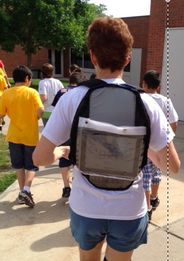
This past week students and staff at an elementary school in my community held a FUNdraising run. I decided to run with them and to incorporate math fact practice while running! I went to a second-hand shop and purchased an old backpack. I cut off the "pack" part, leaving just the back and straps. Then I picked up a heavy duty, clear plastic shower curtain liner. I cut a portion twice the size of my iPad and sewed a pocket with it onto the back of the pack. My iPad fit very snuggly, so that it wouldn't fall out as I ran. Finally, I created a Keynote presentation - each slide was a single math fact or a cheer such as "Go, go, go!" I set the slide show to run automatically, changing slides about every 10 seconds.

Students were challenged to shout out the math fact and answer if they passed me on the run. If I passed the students, they also had to call out the fact and the answer. Watch this short video clip to see how it came together!


Picture
This week I had the opportunity to co-teach at a Delaware high school with some fabulous, flexible teachers. One of the lessons was about right triangle trigonometry. After a quick brainstorming we developed the following activity to increase student engagement (especially necessary last period of the day!)

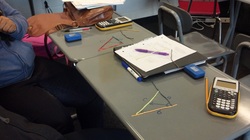
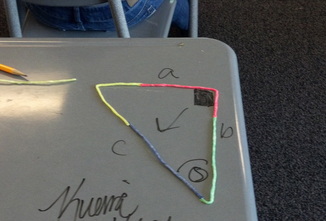
Each student was given Wikki Stix (pieces of string covered in wax) and a dry erase marker. Teachers drew several different triangles on the board. Students formed the same triangles on their desk tops with Wikki Stix. Using the dry erase markers, students wrote directly on the desk tops to label sides, angles and use formulas to determine sine, cosine and tangent. 

We saw 100% participation! Students were jazzed about having permission to write on their desks - it hooked them by having a slight "rule-breaking feel" to it. Forming the shapes with the Wikki Stix kept the students thinking in a hands-on way. And the very visible nature of the work made it easy for teachers to quickly see which students understood the concepts. 


Picture
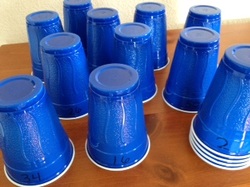
Last week I had the pleasure of observing a co-taught math lesson at Bell Herron Middle School in Carrollton, Ohio. As a motivational strategy, the teachers had designed a “Minute to Win It” activity for students who answered a math problem correctly.  If you have not yet seen this game show, it is based on the idea that there are all kinds of tasks that can be done with simple materials found in the typical household. The tasks look easy at first, but can be quite challenging to accomplish in a minute.

To tap into their students’ interest in this game show, the teachers chose a few of the tasks that could be simulated in the classroom. The one I observed involved the reordering of plastic cups – moving the top to the bottom, over and over again, until each cup had been moved once. The teachers began by projecting a youtube video of the game show’s countdown music and visuals. All the students gathered around to watch and cheer on their classmate. One minute later, success or no, students were back to work on the next problem in hopes that they would get to try Minute to Win It.

Whenever students find something of interest, it makes sense to see if we can find ways to tap into this for learning motivation. So many of the games on Minute to Win It lend themselves to studying the math and science behind successful completion. They also require higher level thinking skills to develop a strategy for winning. Many of the games can also be altered slightly to reinforce specific content. For example, the cup stacking activity can be changed to work on patterning.

Here’s what I did – using a water-based marker, I put an even number on each of 30 cups. Next, I mixed them up and stacked them so that only one number was showing. The “contestant” has to rearrange them so that they are in correct order from 2 to 60 in a minute. (You could use fewer cups for younger students.) You could also do this with alphabetizing words, sequencing colors, or any other concept that has a hierarchical nature. By adding content to the cups, the contestant and observers engage in quick thinking about your topic!


Picture
Many teachers use the Frayer Model (1969) as a vocabulary application activity. The Frayer Model typically involves asking students to fold or divide their paper into four sections. In one quadrant the students write the word and definition, in another they write facts/characteristics, in another quadrant examples, and finally non-examples.

To mix things up a bit, last week I asked a co-teacher to replace her use of the Frayer Model in algebra with a Word Toss activity. We placed students into pairs and provided each pair with a die and a Word Toss worksheet. (See below. I'd be happy to email the worksheet to you!) Students were directed to role the dice and perform the task associated with the number on the face of their die.

The change in routine increased alertness by adding some novelty and tactile interaction to the lesson. Afterward, my co-teacher and I brainstormed alternative tasks that could go on the Word Toss worksheet:


  • Act it out
  • Develop a metaphor
  • Develop an analogy
  • Create a multiple choice question
  • Perform word surgery (dissect into root, prefix, suffix)
  • Transform it (add prefix or suffix)
  • Career Track it (think of a job for which you would need this word)
  • Create a crossword clue
 
 
Picture
Educational experts suggest that each lesson should have a closure activity – something that wraps up the experience or gives students a chance to summarize their learning. Many teachers have chosen to use a Ticket–out-the-Door activity for closure and as a formative assessment.  This is an easy, multi-purpose strategy that can be used with almost any content or grade level.

However, tickets-out-the-door can lose their effectiveness with students if they are overdone. To avoid this problem, consider adding some variety to your tickets! The prompts below can be displayed on the board, reinforced with a printed visual on a ticket, or students can quickly draw the related shape on a scrap of paper. For black line masters of the ticket ideas below, email me at anne@ideasforeducators.com.

·      If you were to fill a grocery cart with key concepts from today’s lesson, what would it contain?

·      If this lesson were a pizza, what would the toppings be?

·      Write a news headline based on what you learned today.

·      What new learning will you walk away with today?

·      Write a recipe for _______________________________.

·      Write a text message summary of what you learned today.

·      How does this information relate to money (the economy, jobs, etc.)?

·      If this concept were turned into a menu, what would be the appetizer? Main dish? Dessert?

·      Complete an analogy, beginning with today’s concept…

·      Write a postcard to a friend or family member explaining what you did in class today.


Picture
Everyone in my household found a scratch-off lottery ticket in their stocking this year. We each experienced a few moments of hope and excitement as we carefully chose the spots to scratch. You can add that same fun* to your classroom instruction with scratch-off stickers. These are available from several websites and are fairly inexpensive. Just print out a list of review items – events, dates, vocabulary- and place a sticker over each item. You can also simulate the experience even less expensively by laminating your review list and dabbing a bit of poster paint over each item. When the paint dries it can be scratched off with a coin, revealing the item underneath.


Originally published in January, 2012. Today we used this strategy in a middle school science class. Each student made a prediction about the outcome of an experiment, then covered over their prediction with a scratch-off sticker. After the experiment, students swapped with a peer and scratched off to see if the predictions were correct. 

This is your new blog post. Click here and start typing, or drag in elements from the top bar.